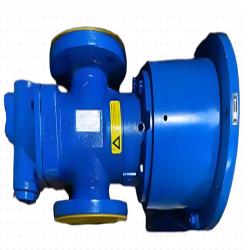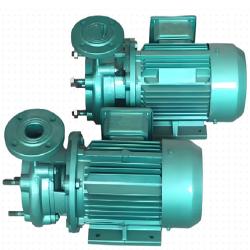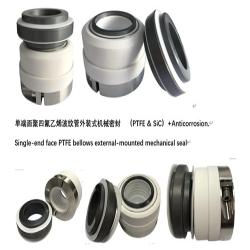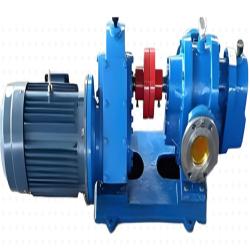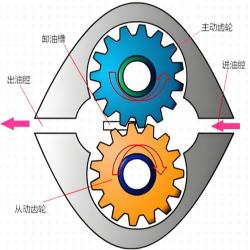


Centrifugal pump with siphon tank for self priming
- Model Number: IH,IS
- Brand Name: kenshine-pump
- Place of Origin: Shanghai, China
- Minimum Order Quantity: 1
- Supply Capacity: 600sets per month/month
- Payment: T/T in advance
- MemberShip: Free Member
- Inquiry Now
IH,IS Centrifugal pump with siphon tank for self priming Description
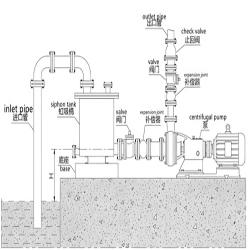
The siphon tank, also known as a vacuum tank or water suction tank, utilizes the
principle of vacuum suction generated by a sealed container. When paired with a
standard centrifugal pump, it achieves self-priming effects (equivalent to a self-
priming pump), with a maximum self-priming height of approximately 4 meters. Its
advantages include easy assembly, simple single-pump maintenance, stable self-
priming performance, and a more cost-effective price compared to self-priming
pumps. The drawback is its relatively large footprint.
The steel lined with plastic siphon tank can be used for conveying general
corrosive clear liquids or slurries such as acids and alkalis.
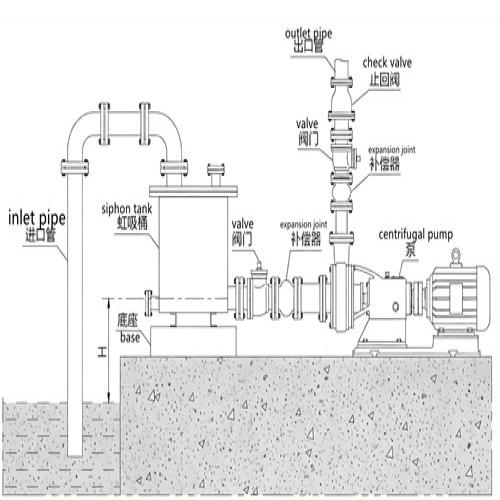
The siphon tank uses a vacuum water tank to draw water. This involves installing a
sealed water tank/reservoir on the suction pipeline between the pool and the pump.
Before starting the pump, the vacuum tank is filled (and the pump is also primed
with water). Once the pump is activated, it first draws water from the vacuum tank,
causing the liquid level in the tank to drop and creating a vacuum in the pipeline.
The pressure inside the pipeline then falls below the atmospheric pressure at the
pool's liquid surface, allowing water to flow into the vacuum tank through the
suction pipeline. When the discharge from the pump and the intake into the suction
pipeline balance, the liquid level in the vacuum tank stabilizes, reaching a steady
operating state. The pump then achieves its rated operating condition, continuously
delivering water. After stopping the pump, water in the discharge pipeline flows
back into the vacuum tank, completing the priming process before startup. This
eliminates the need for manual priming, enabling unattended operation.
Advantages of Siphon Bucket Pump
Siphon Bucket vs. Self-Priming Pump Self-priming pumps have a complex pump body
structure, resulting in relatively higher production and installation costs,
leading to a higher overall price. In contrast, a siphon bucket combined with a
standard centrifugal pump can achieve the same self-priming effect but with lower
individual costs. The pump body is also easier to maintain, and if the pump fails,
only the pump needs to be replaced while the siphon bucket can continue to be used.
In a one-in-use-one-backup setup, a single siphon bucket may suffice, reducing
procurement costs.
Siphon Tank vs. Submersible Pump Conventional corrosion-resistant engineering
plastic submersible pumps, due to manufacturing limitations, have a maximum
submersion depth of no more than 2 meters (longer submersible pumps operate
unstably and have shorter lifespans), making them unsuitable for applications with
deeper pool levels. In contrast, the siphon tank combined with a standard
centrifugal pump can achieve a maximum self-priming height of 4 meters, offering a
broader range of applications.
Siphon Tank vs. Foot Valve: A standard centrifugal pump equipped with a foot valve
at the suction inlet can achieve self-priming. However, if the medium contains
solid particles, it may cause the foot valve to jam or fail to seal tightly,
leading to leakage, which affects the self-priming effect and may even shorten the
pump's service life. In contrast, a siphon tank avoids this issue, delivering
stable and reliable self-priming performance
| flow rate | 0-1000m3/h |
|---|---|
| Pressure | 1.6MPA |
| pump material | cast iron, stainless steel, plastic |
| transfer pump | industrial pump |
| self priming pump | circulation pump |
| drainage pump | booster pump |
| dewatering pump | supply pump |
| china pump | kenshine-pump |
Retaled category: Centrifugal Pump
Hot search: centrifugal pump, industrial pump, self priming pump, supply pump, transfer pump, circulation pump